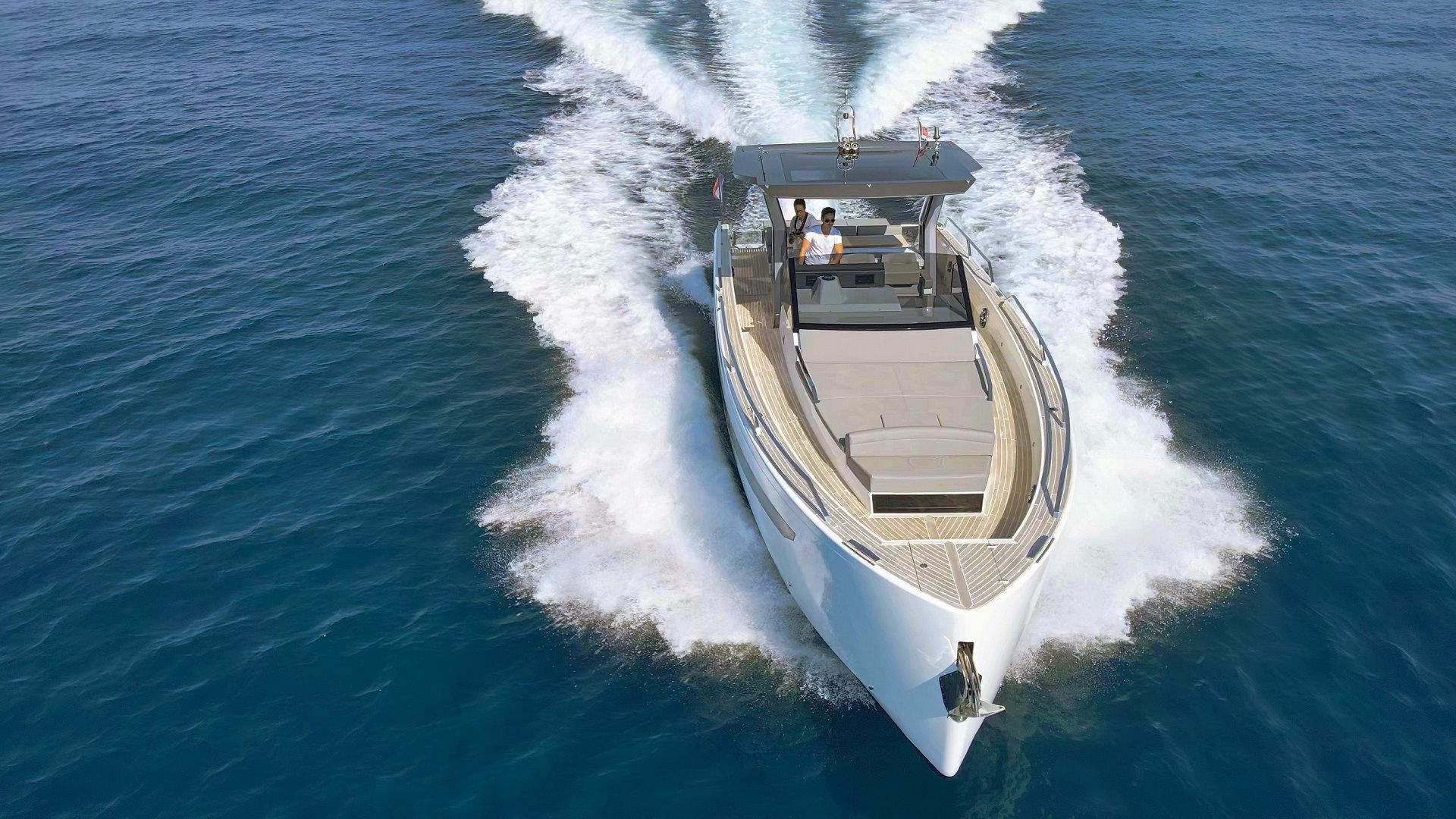
The gap between a yacht that presents beautifully alongside and one that genuinely makes sense for Mediterranean cruising can be considerable. A useful guide to buying a yacht in the Mediterranean is not about choosing the most appealing boat in photographs: it is about securing a decision that stands up technically, financially and in daily use.
The Mediterranean attracts very different buyers. Some want a boat for day trips between Antibes and Saint-Tropez. Others are looking for a vessel able to cruise for several weeks, with crew, tenders, stabilisers and comfortable range. That distinction changes everything. You do not buy a 14 metre open, a 22 metre flybridge and a 35 metre yacht intended for mixed private and charter use in the same way.
Why buying in the Mediterranean calls for real method
The Mediterranean market is dense, international and fast moving. The finest boats often sell before they are widely exposed, while others remain on the market for a long time for good reasons that photographs never reveal. Location, maintenance history, the calibre of the previous crew, the seriousness of the owner and even the original yard all weigh heavily on true value.
The region also brings its own criteria. Draught can become an issue depending on the anchorages you have in mind. Beam affects berth availability and therefore cost. With use concentrated between May and September, a disciplined buying timetable is essential if you intend to be cruising soon after the transaction.
Buying here, in other words, is not simply a matter of finding a yacht. It is a matter of finding the right boat, at the right price, with the right level of risk.
Defining the brief before you view
The first mistake is to start with the listings. The better approach is to frame actual use. Do you want day trips, ten days away with the family, entertaining alongside, a few weeks of charter, or a purely private asset? Each answer alters the ideal format.
A buyer who mainly heads out from the Cote d'Azur will not share the priorities of an owner who regularly runs to Corsica, Sardinia, the Balearics or Greece. Speed, fuel burn, cabin layout, crew space and comfort at anchor carry different weight in each case.
The budget deserves the same candour. The purchase price is only a starting point. VAT status, flag, insurance, berthing, maintenance, crew salaries where required, improvement works and compliance costs all need to be factored in. A yacht that looks attractive on price can prove a poor choice if its running costs outstrip the way you intend to use it.
New or pre-owned: a question of profile rather than prestige
A new build offers customisation, warranties and a straightforward history. In return, it usually means delivery times, marked initial depreciation and demanding project management.
A pre-owned yacht can open the door to a larger class, already equipped and available sooner. It does, however, require far closer technical analysis. A ten year old yacht that has been meticulously maintained may be a wiser purchase than a newer boat neglected on essentials.
The technical criteria that genuinely matter
In any serious Mediterranean buying guide, engineering must come before presentation. Aesthetics count, of course, but they should never obscure the structural, mechanical and operational condition of the boat.
Engines remain central, though not the whole story. Hours should be read with nuance. Very low hours across several seasons can point to under use and, at times, irregular servicing. Conversely, an engine that has worked harder but been maintained to specification may present a more reassuring profile.
The quality of maintenance shows in the invoices, the coherence of the work carried out, the state of the engine room, corrosion levels, the cleanliness of installations and the general logic of the boat. A well kept yacht is often recognised in details few buyers look at instinctively: cabling, technical access, the condition of the bilges, onboard documentation, redundancy in key systems.
The hull and underwater sections also warrant inspection, along with stabilisers, generators, air conditioning, electronics, the watermaker, safety equipment, the tender and the side decks. On vessels of 20 metres and above, the quality of the crew areas and the ergonomics of operation have a real bearing on how satisfied the owner will be later.
A survey is not a formality
A proper survey is not there to confirm a desire. It is there to measure risk. That calls for a competent, independent surveyor, careful reading of the findings and the ability to turn defects into a negotiating position or a decision to walk away.
Not every defect is prohibitive. Some are normal for the age of the boat. Others justify a significant reduction. Others still reveal a structural lack of rigour and should end the discussion. The difference lies in the experience brought to reading the file, not in the sheer volume of technical pages.
The sea trial: the decisive moment
A yacht is also bought under way. The sea trial allows you to check acceleration, vibration, course keeping, handling, noise levels, the operation of equipment and the overall consistency between what the seller says and what the boat does.
This is usually when the weak signals appear. Imprecise controls, temperamental electronics, unstable air conditioning, unconvincing stabilisers or an unusual noise can seem minor during a visit alongside. They take on a different dimension once the boat is working.
In the Mediterranean, where anchorages, crowded ports in season and occasional fast passages alternate, ease of operation deserves to be taken seriously. A technically well specified yacht that is tiresome to run rarely makes for a good ownership experience.
The right price is not the asking price
The premium yachting market rarely behaves like residential property. The asking price reflects a marketing strategy, not an indisputable value. It has to be tested against the boat's actual year, its equipment, its refits, its history, its flag, its tax position, any berth attached to it and genuinely comparable vessels that have sold.
Negotiation should stay precise and evidenced. Too aggressive an approach closes doors unnecessarily. Too accommodating an approach gives away value from the outset. The right balance is to argue from verified facts: work to be anticipated, differences in equipment, points raised by the survey, market seasonality, time on the market.
This is where experienced representation makes a tangible difference to the outcome. An eye accustomed to the market can identify a correctly positioned boat, a quiet opportunity or a yacht that is overvalued despite a flattering presentation.
Tax, flag and ownership structure
These questions are too often raised too late. Yet the way you buy affects total cost, future use and resale. Personal ownership or through a company, French or foreign flag, with or without a charter programme: each option carries implications.
There is no universally preferable structure. Everything depends on your tax residence, your cruising programme, the principal area of operation and the purpose the yacht serves. What suits an owner-operator with a 15 metre boat will not necessarily suit a 30 metre yacht with crew and partial commercial use.
Prudence dictates settling these matters before signature, with competent advisers. A poorly structured decision is difficult to correct afterwards.
After the purchase, what makes the difference
A successful purchase does not end at the transfer of title. Handover, insurance, berthing, immediate maintenance, any upgrades and crew recruitment all need to be organised. For some owners, practical training on board matters as much as a well conducted negotiation.
That is particularly true of a first yacht of any real size. Comfort of use then depends as much on post-purchase support as on the boat itself. At YachtDeals, this phase is treated as an integral part of the project, because a well advised owner makes better decisions from the very first season.
The most expensive mistakes
In this market, errors do not always stem from a bad boat. More often they stem from a poorly defined brief. Buying too large for the intended use, underestimating annual costs, overlooking the berth, relying on a superficial survey or rushing to be ready before summer are all common failings.
The other mistake is to confuse emotion with judgement. Emotion has its place in buying a yacht and is part of the pleasure. But it should come after the fundamentals have been checked, not instead of them.
A good Mediterranean purchase is one that still makes sense one year, three years and five years later. It should be enjoyable to use, rational to maintain and defensible on resale. It is that coherence, rather than a signature name or a fashionable yard, that truly protects your investment.
If you are considering an acquisition, let one simple question precede every viewing: does this yacht match my actual programme, or only an appealing idea of it? The quality of a purchase very often begins with that clarity.