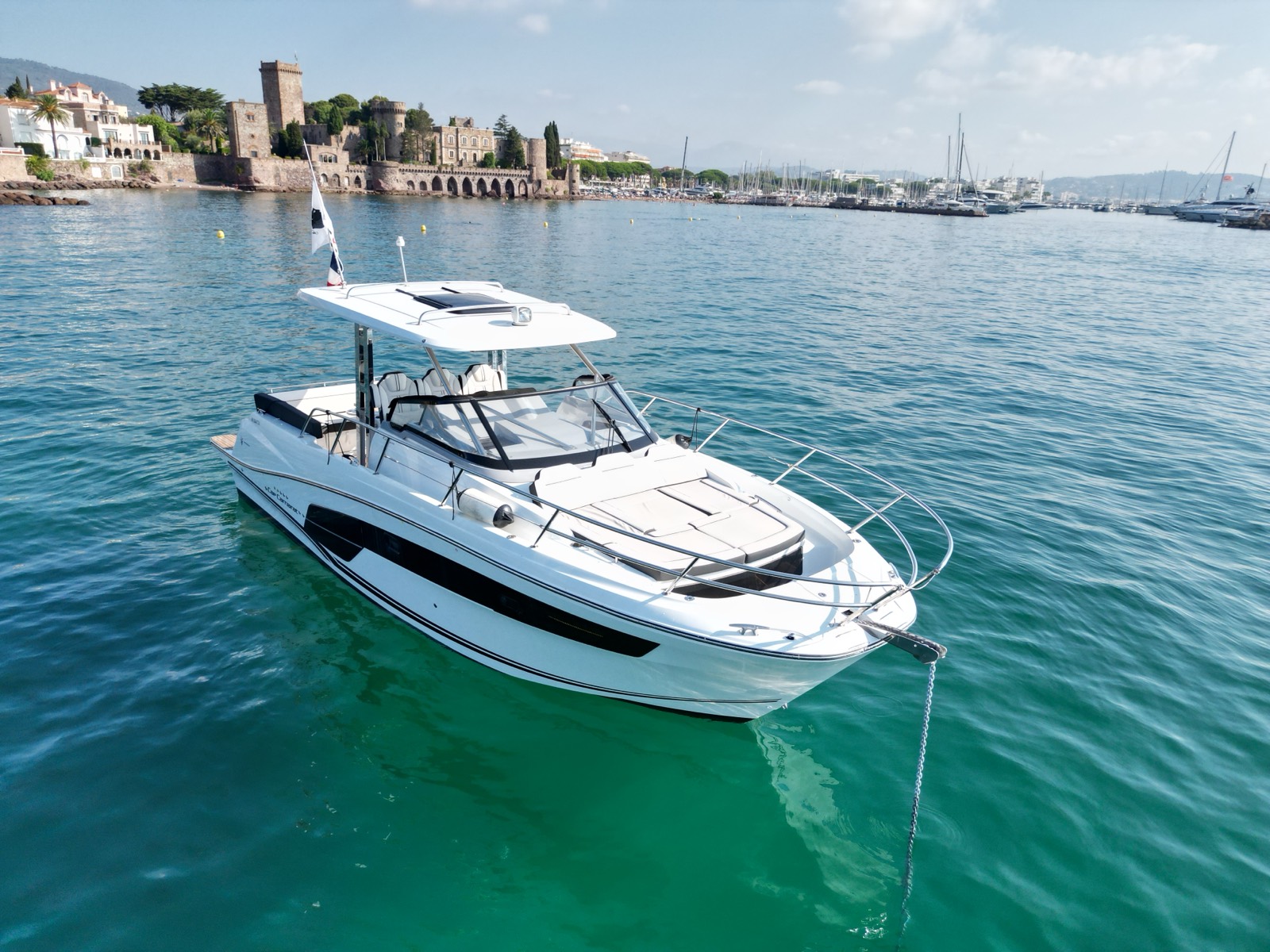
Buying a first yacht is not a purchase like any other. In this market, an elegant profile, a flattering interior or an apparently attractive price can conceal a boat poorly suited to your programme, expensive to run or difficult to sell on. Deciding how to choose a first yacht therefore begins with a simple question: what will you genuinely use it for, and in what conditions?
Choosing a first yacht around your programme
The first criterion is neither the marque nor the length. It is the way you intend to use the boat. An owner who wants day trips between Cannes, the Iles de Lerins and Saint-Tropez does not have the same requirements as a buyer planning cruises of several weeks in the Mediterranean with family, guests and crew.
If day boating is your main use, movement around the deck, stability at anchor, easy access to the water and straightforward handling will matter far more than an additional cabin. For a cruising programme, by contrast, range, comfort under way, stowage, the quality of the air conditioning, sound insulation and the layout of the sleeping accommodation become decisive.
This is often where the first mistakes are made. Many buyers over-specify. They buy for exceptional scenarios rather than for their regular use. Yet a yacht should be chosen for 80 per cent of its actual use, not for the 20 per cent of idealised weeks in the year.
Day boating, weekends or extended cruising
A yacht of 12 to 16 metres can suit an owner who favours short outings, coastal anchorages and relatively simple handling. Beyond that, the experience changes. More length generally means greater comfort, more volume and a better feel at sea, but also higher running costs, scarcer berths and more structured management.
There is no correct size in absolute terms. There is a size consistent with your rhythm, the people around you and your level of involvement. A very comfortable yacht that is too complex to use on impulse often ends up going out less than expected.
Setting a realistic budget, not simply a purchase price
The acquisition price is only the beginning. Choosing a first yacht sensibly means factoring in all annual costs: berthing, insurance, routine upkeep, technical maintenance, hauling out, consumables, crew where applicable and the unforeseen. On a yacht, it is rarely the visible expenditure that causes difficulty, but the sum of the items underestimated at the outset.
A prudent buyer therefore sets two separate envelopes. The first covers the purchase. The second, just as important, covers annual operation. That distinction avoids a common situation: committing the maximum to the boat itself, then economising on its upkeep or deferring essential work.
The brokerage market can offer excellent opportunities, provided a low price is not mistaken for a good buy. A yacht listed below the market may conceal a vague history, ageing systems or a substantial programme of works. In the upper segment, real value lies as much in condition, record keeping and overall coherence as in year or builder.
New build or pre-owned
A new boat is reassuring in certain respects. You benefit from current equipment, greater scope for personalisation and clear visibility over the early life of the yacht. In return, lead times can be long, the initial depreciation is real, and the specification demands serious involvement if you are to avoid purely aesthetic choices at the expense of practicality.
The pre-owned market often gives access to a larger or better equipped boat for a comparable budget. It is also more responsive. But it calls for an experienced eye. Two yachts of the same model can differ considerably in value and usability depending on maintenance, previous crew, refits carried out and how they have been operated.
For a first purchase, a well selected pre-owned yacht is often the sound route, provided you are advised rigorously rather than guided by the brochure and the photographs.
The technical points that genuinely matter
A first yacht should be pleasant to live aboard, but also straightforward to operate. That means looking beyond the visible finish. Propulsion, engine hours, service history, hull condition, generators, electronics, tenders, stabilisers, air conditioning and hydraulic installations all need to be examined methodically.
The quality of a boat is often revealed in quiet details. An engine room that is clean and, above all, intelligently kept, complete documentation, traceable works, a coherent maintenance philosophy and the absence of successive improvisations are valuable indicators. Conversely, a yacht that charms on a viewing can prove demanding and expensive from the first season if it has been technically neglected.
Propulsion, upkeep and resale
The right choice is not always the most powerful. Consider the type of boating you have in mind. High speed can look appealing on paper, but it usually brings higher consumption, harder worked machinery and heavier running costs. For some owners, a calmer, better balanced and less demanding boat will be the wiser choice.
Think about resale from the outset. Certain configurations sell more readily in the Mediterranean market: a sensible number of cabins, appropriate crew accommodation, a recognised builder, documented maintenance and a clear VAT and administrative status. A first yacht should also be chosen with at least some regard for value retention.
With or without crew?
The question is central and often underestimated. Between 12 and 15 metres, some owners prefer to remain independent or to keep assistance to a minimum. That can make sense if the boat genuinely lends itself to it and the programme stays simple. Beyond a certain level of complexity, however, crew is not a comfort. It is a matter of safety, of preserving the boat and of using it easily.
A qualified captain or deckhand changes the experience aboard entirely. Manoeuvres are calmer, routine maintenance better monitored, departures more spontaneous and the value of the yacht better protected over time. Again, much depends on the size of the boat and your own availability. Managing everything yourself can seem rational at the point of purchase, then become a burden a few months later.
Home berth and practical logistics
On the Cote d'Azur, the berth is a strategic subject. It affects not only the budget but also how often the boat is used. A yacht that looks perfect on paper loses much of its point if it is moored far from where you live or if the logistics complicate every outing.
The home berth deserves the same scrutiny as the boat itself. Access, seasonality, size restrictions, available technical services, security, provisioning and ease of embarkation for your guests all have a direct bearing on your experience as an owner.
A boat that is easy to take out is used more. A simple principle, but a decisive one.
Viewing properly and surveying without indulgence
A first viewing is there to eliminate, not to persuade. Look at movement around the boat, the real sense of space, visibility from the helm, noise levels, technical odours, the state of the upholstery and, above all, everything not visible at first glance. If a doubt arises, it should be addressed immediately rather than rationalised.
A survey and a sea trial are non-negotiable. They allow you to check how the yacht behaves, the consistency of engine temperatures, the operation of the systems, vibration, alarms, the general response of the boat and the true standard of its upkeep. A clean file reduces risk. A proper survey measures it.
In this exercise, good advice makes the difference. An experienced broker is not simply there to conclude a transaction. He should be able to advise you against a boat, however attractive, if its condition, past use or future cost do not match your project. It is precisely here that the operational experience of a firm such as YachtDeals brings tangible value.
Neither too quickly nor too late
Timing matters. Buying under pressure often leads to poorly judged compromises. Waiting too long can mean missing a rare boat, well maintained and correctly priced. The sound approach is to define your criteria, view enough to calibrate the market, then decide quickly once the essential boxes are ticked.
A first yacht does not need to be perfect. It needs to be right. Right for your use, right for your overall budget, right for your level of involvement, right for how long you intend to keep it. That coherence is what turns an appealing purchase into genuinely successful ownership.
The best decision, then, is not the one that impresses most on the pontoon. It is the one that will make you want to go to sea often, with peace of mind and no regrets from the first season.