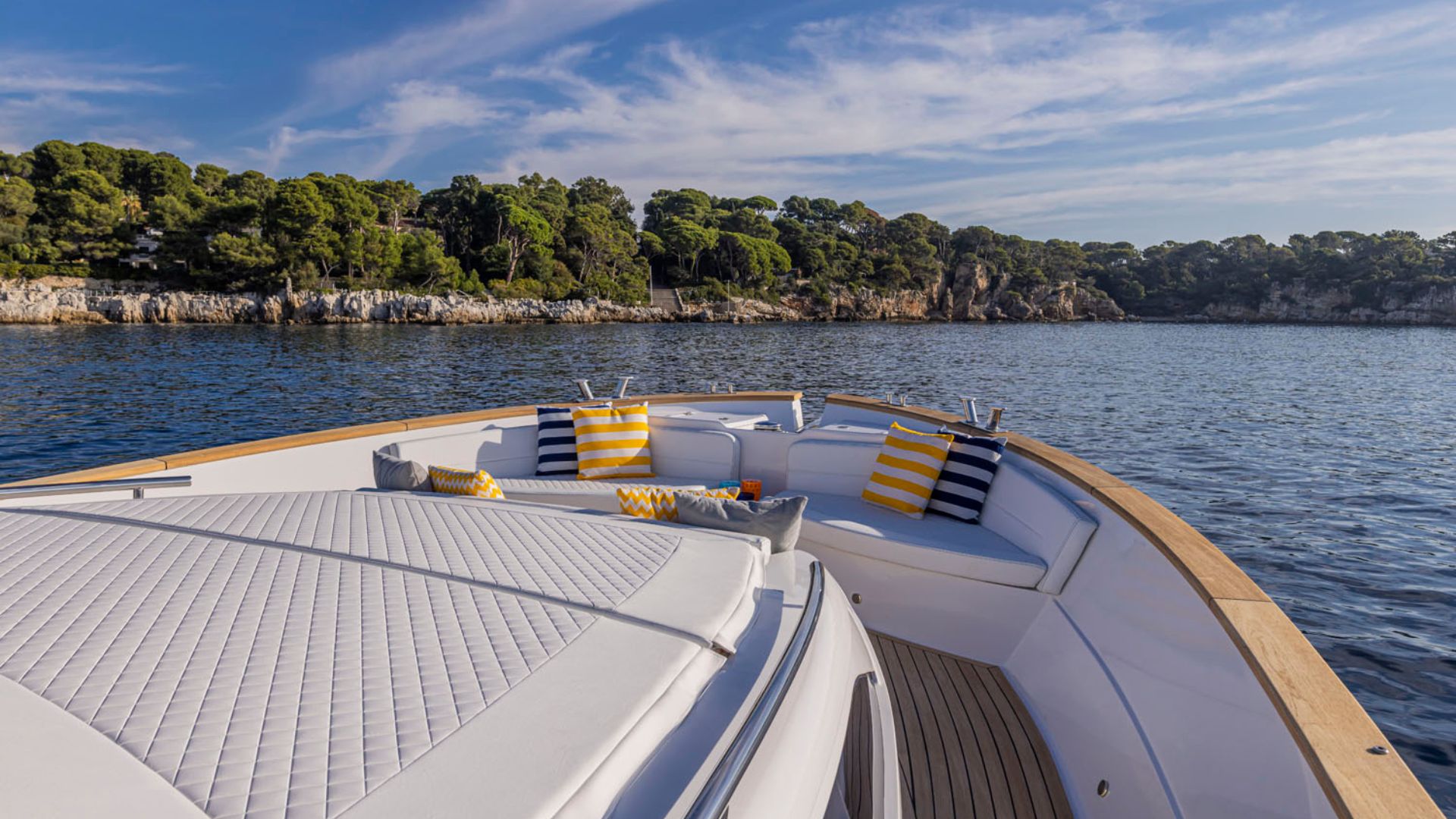
A few miles from Monaco, Antibes or Cannes, a yacht can look faultless at first glance and yet, once surveyed, reveal costly gaps between presentation and reality. That is the central issue when buying a yacht on the French Riviera: in a market that is attractive, fast moving and highly international, the quality of the decision matters more than the speed of execution.
The right boat is not simply the one that matches a length, a builder or a profile. It is the one that suits a clearly defined cruising programme, sits within a sound legal framework, shows a consistent standard of maintenance and carries a cost of ownership the owner is content to bear. In this segment, mistakes are not easily undone. They are paid for in downtime, technical overruns, depreciation at resale or disappointing use.
Buying a yacht on the French Riviera: a market of opportunity, but a demanding one
The Riviera offers a concentration of stock that is rare in Europe. Recent units, exceptionally well maintained yachts, experienced owners, qualified crew and a network of yards able to act quickly. For a buyer, that is a genuine advantage. Viewings can be arranged back to back across several ports, sea trials organised efficiently and comparisons made more easily than elsewhere.
That density has its downside. Price levels are driven by international demand, the best units change hands discreetly, and some listings present a boat that is more appealing on paper than in inspection. On the Riviera, competition is not only about price. It is about access to accurate information, the right timing and the right intermediaries.
A well advised buyer is therefore not simply looking for a yacht for sale. They are looking for a reliable filter. The difference between a fine opportunity and a poor acquisition often turns on points that are barely visible at the outset: maintenance history, quality of refits, consistency of engine hours, the true standard of equipment, the structure of annual costs and future ease of resale.
Defining the right project before choosing the boat
Before any discussion of builders or models, the intended use must be framed. A 15 metre yacht for day trips between the Lerins islands and Saint-Tropez is not bought in the same way as a 30 metre unit intended for longer cruising with crew and guests. The right question is not only which yacht to buy, but for what rhythm, what level of comfort and what constraints.
Size determines far more than appearance. It affects crew requirements, berthing, maintenance costs, access to certain ports, fuel consumption and life on board. Between 12 and 18 metres, ownership can remain relatively straightforward for an owner who is properly supported. Beyond that, one generally moves into a more structured form of operation, with technical and administrative management that should be anticipated from the point of purchase.
The choice between a motor yacht, an open, a flybridge, a sportscruiser or a long range cruising unit should likewise be dictated by actual use. Some clients want above all an elegant boat for entertaining. Others are looking for a stable family platform, easy to run, with a well conceived owner's cabin and comfortable range. Others again want to protect strong resale value in models with an established following on the brokerage market. These trade offs are never purely emotional, even if emotion is part of any purchase.
The real question: the yacht's condition, not just its year
When buying a pre-owned yacht on the Riviera, the build year is a reference point, not a guarantee. Two units that appear identical on paper can differ considerably depending on the quality of the record keeping, the standard of works carried out and the rigour with which the boat has been run.
A well maintained boat with complete documentation, a proper engine record and coherent works can offer more security than a newer unit with a vague history. This is particularly true of yachts at the top of the market, where the calibre of successive owners and technical teams weighs heavily on true value.
Inspection must therefore go well beyond upholstery, varnish and the tidiness of the cabins. The bilges, technical spaces, electrical installations, air conditioning, generators, electronics, auxiliaries, deck condition and the overall logic of maintenance all need examining. A former captain or a broker who understands how these yachts are actually run will spot within minutes what an inexperienced buyer would miss.
Purchase budget and cost of ownership: clear sightedness protects
The asking price is only the starting point. In a Riviera purchase, the real budget takes in acquisition costs, any immediate works, the flag, insurance, berthing, routine maintenance, yard periods and, depending on size, crew.
This is often where the quality of the advice shows. Sound counsel is not about pushing a client to the top of their budget. It is about preserving the balance between enjoyment of the boat and sustainability of the costs. A yacht bought at the ceiling of a budget, but which soon demands a mechanical refit, equipment replacement or an unduly heavy organisation, becomes a source of constraint.
Conversely, a unit that looks slightly less spectacular on paper may offer a better balance between use, safety and capital value. Good judgement means buying well rather than buying big.
Tax, registration and flag: matters to settle early
On the Riviera, many transactions involve foreign sellers, corporate structures, various flags and international patterns of use. VAT status, ownership structure, documentary compliance and the yacht's intended area of operation must be clarified at an early stage.
A boat may look competitively priced, then become less attractive if its administrative position is poorly framed or if its future use creates avoidable tax constraints. The owner's nationality, the cruising area, whether professional crew are engaged and the possibility of charter all change the analysis.
This is no place for improvisation. The right structure depends on the actual project. It should be studied before a firm offer is made, not after signature.
Viewing, offer, survey, sea trial: method makes the difference
A secure purchase follows a clear sequence. First, a tightly drawn selection of yachts consistent with the programme. Then prepared viewings, with the right questions and the right points to check. Next comes the offer, which must protect the buyer through appropriate conditions, particularly on survey and sea trial.
The trial is not a formality intended to confirm that the yacht runs in a straight line. It is there to observe temperatures, vibration, handling under manoeuvre, general behaviour, the condition of systems and whether stated performance matches reality. The survey, for its part, must be conducted rigorously and then read with judgement. Not all defects carry the same weight. Some justify a renegotiation, others a retention pending rectification, and others should lead the buyer to walk away altogether.
On this point, candour is worth more than a commission. A serious intermediary must be able to say no to a boat that does not live up to its promise, even when the deal appeared close.
Why negotiation is about more than price
In premium yachting, good negotiation is not only about securing a reduction. It aims to improve the overall quality of the transaction. That may mean the seller undertaking certain works, equipment being included, the timetable being adjusted, documentary points being clarified or delivery terms being made watertight.
The final figure does not tell the whole story. Two purchases at the same price can be of very different quality depending on the yacht's condition on the day of delivery, the documentation handed over, the retentions dealt with and the standard of preparation before handover.
Good brokerage brings a dispassionate reading of the market. It distinguishes a realistic seller from an inflexible one, a correctly positioned yacht from one priced above its value, and a file that will run smoothly from one likely to become bogged down.
After the purchase, the real work begins
Many buyers focus their attention on the transaction, then discover the realities of operation afterwards. Yet the success of a purchase is also measured in the months that follow: the quality of the handover, the organisation of maintenance, any crew recruitment, management of the berth, the planning of technical works and preparation for the season.
This is where full support proves its worth. Familiarising the owner with the yacht, structuring the first passages, anticipating technical deadlines and keeping a clear view of the boat's value turns an acquisition into an untroubled experience. For a demanding clientele, the real luxury often lies there: losing no time, avoiding the known pitfalls and enjoying the boat properly from the very first summer.
In a market such as the French Riviera, buying a yacht is not an impulsive act, even when the attraction is immediate. It is a decision that deserves perspective, hands on experience and an eye able to see what the photographs do not show.