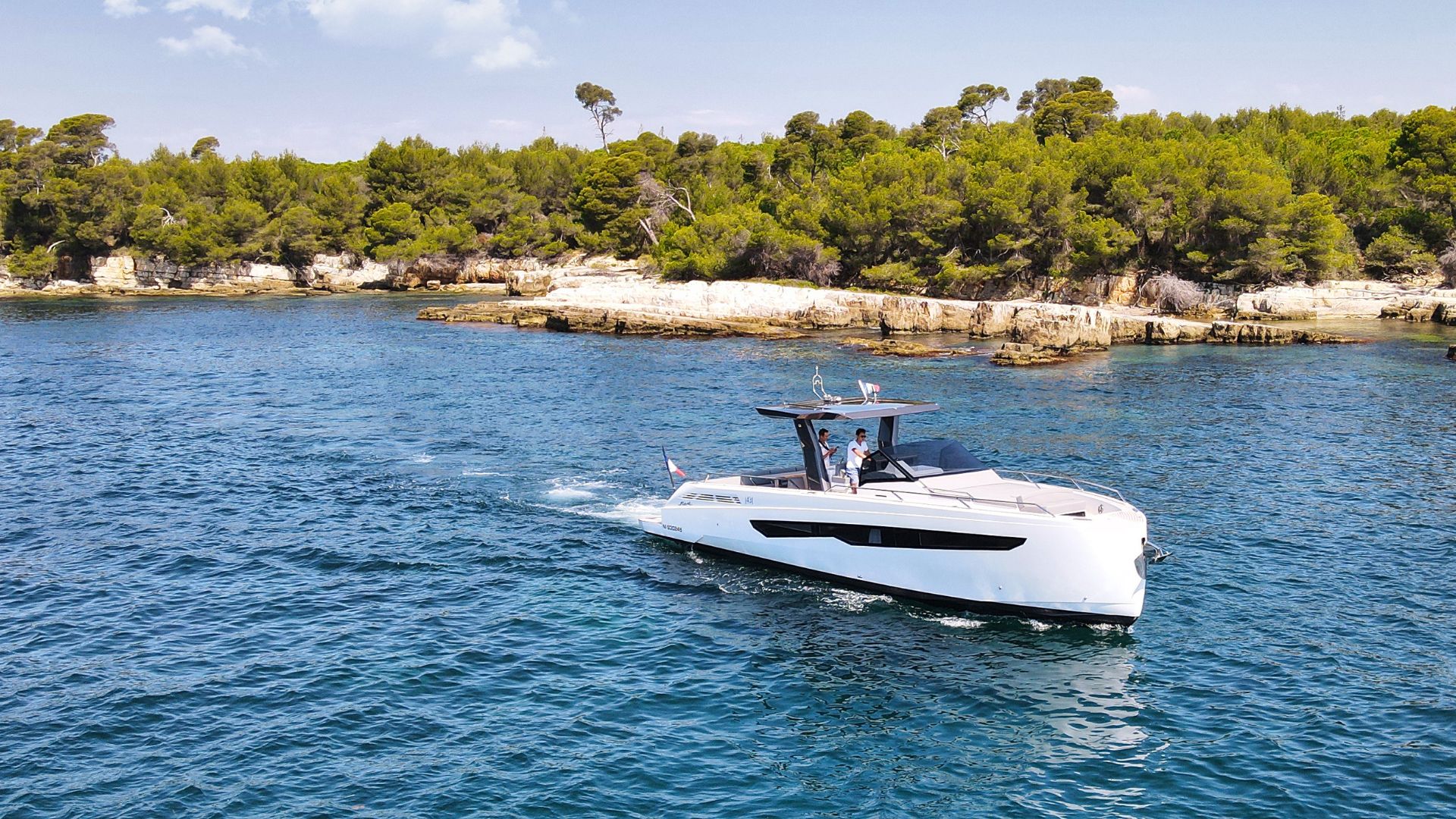
In Antibes, Cannes or Monaco, buying a yacht on the French Riviera is not a matter of picking a silhouette on the quay. The real work begins where the listings end: the true condition of the vessel, its fit with your intended use, the level of running costs, the quality of technical follow-up and the ability to resell on sound terms. In this market, mistakes are never theoretical. They cost time, money and sometimes several seasons.
The Riviera holds a concentration of stock that is rare in the Mediterranean. That is a clear advantage when it comes to comparing several vessels quickly, meeting crews, reviewing maintenance histories and moving decisively when the right yacht appears. But this density has its flip side. Many boats look alike on paper; few genuinely compare once properly inspected.
Why buy a yacht on the French Riviera
Buying on the Riviera means access to a highly liquid, international market built around major ports such as Antibes, Cannes, Golfe-Juan, Nice and Monaco. Motor yachts, opens, flybridges, sport cruisers and long-range vessels are all represented across a very wide size range, with a strong concentration between 12 and 40 metres.
For a buyer, that changes everything. You can view several comparable yachts in a short space of time, cross-check market data more easily and gauge the gap between asking price and defensible value. It is also a basin where vessels are looked after by experienced professionals, with histories that are more legible than in more scattered markets.
A note of caution is still in order. A fine presence on the berth, a recent refit or a lavish interior are not in themselves justification for a price. A yacht can be seductive on a viewing and poorly managed technically. At this level, judgement is worth more than aggressive negotiation.
Buying a yacht on the French Riviera: start with the right brief
A well-run purchase rarely begins with a specific model. It begins with use. Do you want day trips between the Iles de Lerins and Saint-Tropez, several weeks away with the family, a permanent crew on board, or a mix of private use and charter? The right yacht is not the most spectacular one. It is the one that serves your programme without creating unnecessary constraints.
Size, for instance, deserves genuine thought. Between 12 and 18 metres, operating patterns tend to remain more flexible, with crew and berthing costs more contained depending on the port. Above that, comfort increases markedly, but so do the running costs: maintenance, insurance, consumables, winter lay-up, crew and regulatory compliance. The gain in space is real. So is the level of commitment.
The choice between a recent pre-owned yacht, an older refitted vessel or a new build depends on the buyer's profile. A recent boat offers reassurance on certain items and limits short-term works, but the entry price is higher. A well-maintained vessel a few years old can deliver an excellent value-to-enjoyment ratio if its history is rigorous. New build answers to a very specific ownership and usage logic. It offers personalisation, but demands lead times, technical trade-offs and a clear vision of the project.
What to check before making an offer
The premium market does not forgive approximation. Before any offer is tabled, several points must be examined methodically.
Maintenance history is central. Invoices, maintenance logs, engine work, generator services, electronics, air conditioning, antifouling, upholstery, tenders and safety equipment: taken together, they should tell a coherent story. An accumulation of small deferred jobs often says more than one recent major repair.
Legal title is equally sensitive. The identity of the seller, the register of ownership, any registered charges, the VAT position, contracts in force and, depending on the case, the flag and previous use all need to be verified. A yacht that has been chartered is not necessarily a poor buy. What matters is understanding how it has been operated, maintained and documented.
Then comes the survey. A sales viewing is never a substitute for an independent technical inspection and a proper sea trial. Hull, structure, engines, shaft lines or transmissions, electrical systems, hydraulics, stabilisation, watermakers, air conditioning and onboard electronics: each item must be assessed precisely. The aim is not to find a perfect boat, which does not exist. It is to identify what is normal, what is negotiable and what should bring the matter to a close.
Asking price, purchase price, true cost
On the Riviera, the asking price is only a starting point. Sometimes it reflects the market. In other cases it reflects an ambitious position taken by the seller, recent works he hopes to recover, or simply a margin built in for negotiation.
A shrewd buyer thinks in terms of true cost of ownership. He looks at the acquisition price, but also at the immediate post-sale expenditure, the upgrades required, the annual operating budget and the likely resale value in three to five years. That is often where the quality of a purchase is decided.
A yacht bought slightly above the odds but technically clean, well documented and correctly engined can cost less than an apparent bargain requiring heavy catching up. Conversely, paying a premium for a purely cosmetic refit with no structural or mechanical benefit is rarely good arithmetic.
The value of experienced brokerage support
In this market, a good intermediary does more than open doors. He qualifies the offering, sets aside vessels that do not stack up, reads between the lines of technical files and protects the buyer's time. That role matters all the more when the buyer lives outside the region, has limited availability or wishes to maintain a high degree of discretion.
The value of proper representation also shows in the negotiation. Negotiating is not about asking for a reduction as a matter of principle. An offer must be supported by concrete elements: market comparables, upcoming maintenance milestones, survey findings, the vessel's genuine appeal on resale. A well-constructed negotiation protects the relationship between the parties and secures the transaction.
At a house such as YachtDeals, that value rests above all on operational experience. Being able to read a boat beyond the brochure changes the quality of the advice. It makes it possible to steer a client towards a vessel that is less flattering at first glance but sounder, better suited and easier to defend over time.
The most common mistakes buyers make
The first mistake is buying too quickly after an emotional viewing. The second is underestimating the cost of ownership. The third, less visible but very common, is misjudging size and crew relative to actual use.
There is also an error of perspective. Many buyers focus on the coming summer and not enough on the two years that follow. Yet a yacht is bought with its eventual resale in mind. A well-regarded builder, a sought-after configuration, a clear history and consistent maintenance make the exit considerably easier. That parameter belongs in the equation from the outset.
Finally, some buyers chase the best deal at all costs. On paper the idea is rational. In practice, the genuinely good buys are rarely the cheapest. They are the most coherent.
How to move forward effectively
If your project is a serious one, the best approach remains straightforward. Define your programme precisely, set a realistic budget that includes operation, shortlist a small number of good-quality vessels, then run the technical and legal checks before any final decision.
On the Riviera, speed counts, but it must never replace rigour. A handsome boat is spotted quickly. A good purchase is built. That distinction is what protects both your investment and your enjoyment at sea.
Buying a yacht is a personal commitment as much as a working asset. Chosen with method, it becomes a natural extension of the way you live in the Mediterranean. Chosen on an impression, it can quickly become a burden. The right decision is not the most dazzling one. It is the one that still holds good once the boat has left the harbour.